
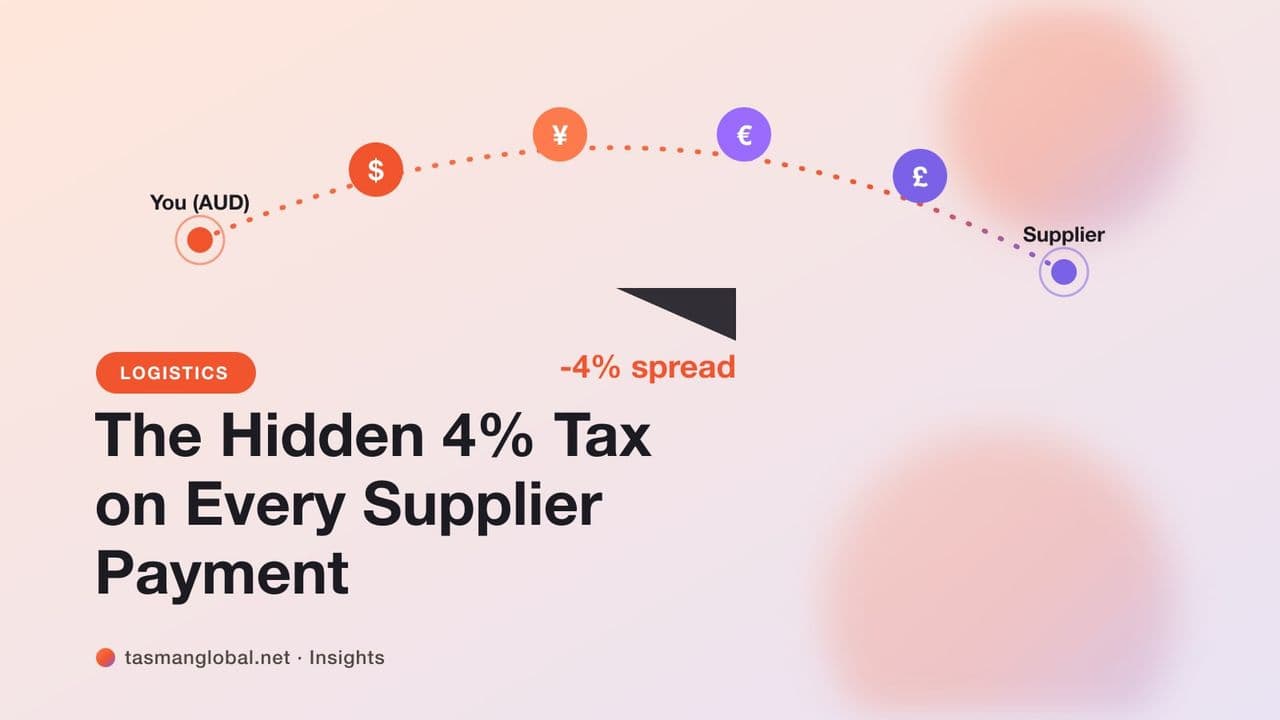
You beat your supplier down on price. Then your bank undid all of it.
Picture the last time you paid an overseas supplier.
You spent weeks getting the quote right. You pushed on the unit cost, argued over MOQ, squeezed the shipping terms. You got it to a number you were happy with.
Then you sent the money — and somewhere between your account and theirs, a slice of it vanished. No invoice. No line item. Just a slightly worse exchange rate than the one you saw on Google, plus a “$30 international transfer fee” for good measure.
That slice has a name. It’s the FX spread, and for most Australian importers it’s the single most expensive thing they never negotiate.
Where the money actually goes
Here’s the part banks would rather you didn’t do the math on.
When you send AUD to pay a supplier in USD, the bank quotes you an exchange rate. It looks official. It is not the real (“mid-market”) rate — it’s the real rate with a markup baked in, usually 3% to 5%. That markup is invisible because it’s hidden inside the rate, not shown as a fee.
Run the numbers on a modest importing operation:
- You pay suppliers US$20,000 a month — a fairly ordinary volume.
- A 4% spread costs you US$800 every month.
- Over a year, that’s US$9,600 — gone. On money you were always going to send anyway.
That’s not a rounding error. That’s a shipping container. That’s your next product line. That’s the difference between a good margin and a great one — quietly leaking out the back door twelve times a year.
And notice what makes it so easy to ignore: it never shows up as a cost you can point at. You just receive slightly less product margin than your spreadsheet promised, and you assume that’s just how importing works.
It isn’t.
How experienced sellers handle it
Somewhere along the way, most serious cross-border sellers stop paying suppliers through their bank. Not because they found a hack — because they found the tool banks were competing against and hoping you’d never hear about.
One of the names that comes up again and again is WorldFirst — a payments platform built specifically for businesses that buy and sell across borders. It’s used by hundreds of thousands of importers, exporters and marketplace sellers worldwide, and it’s designed around one idea: the money you move internationally should stay yours.
Here’s what changes when you run supplier payments through it instead of a bank.
You hold multiple currencies in one account. Open local-currency accounts — USD, GBP, EUR, CNH and more — without opening a foreign bank account. Get paid in the currency your marketplace pays out in, hold it, and spend it as that currency when you pay your supplier. No forced conversion, no double dip.
You pay suppliers at rates close to the real one. Instead of a hidden 3–5% baked into the rate, you convert at rates that sit far nearer the mid-market number. On that same US$20,000 a month, keeping even most of that spread puts thousands back in your pocket a year.
You collect marketplace payouts locally. Selling on Amazon, eBay or other platforms overseas? Receive your payouts into a local receiving account rather than having the marketplace convert everything back to AUD at their rate first. If you both earn in USD and spend in USD, you can skip conversion entirely on a big chunk of your cash flow.
You stop paying the “$30 per transfer” tax. Transparent, business-friendly pricing instead of a fixed sting on every single payment.
“Is switching a hassle?” — the honest answer
Fair question. Most people assume anything involving international payments means paperwork, waiting and a compliance headache.
Registration is done online and built for businesses, not enterprises with a treasury department. You set up your account, get verified, and you’re moving money — usually faster than opening the equivalent facility at a bank. You don’t need to change who you bank with. You just stop letting them handle the expensive part.
The quiet math of doing nothing
Here’s the thing about the FX spread: it costs you the exact same amount whether you think about it or not. Every month you keep paying suppliers the old way is another few hundred (or few thousand) dollars you’ve agreed to give away without meaning to.
If you’re moving money overseas regularly, it’s worth an afternoon to see the rate difference on your own numbers. Not because someone told you to switch — but because once you’ve seen the gap on a real invoice, the old way is hard to justify.
You can set up a WorldFirst account here and see the rates against what your bank last quoted you.
A bonus worth knowing about: New customers who register through the link above and enter the invitation code WFPA can receive US$200 cashback after spending over US$2,000 through the account. Think of it as WorldFirst covering the first slice of what your bank would otherwise have taken. T&Cs apply.
Tasman Global helps Australian businesses source, import and sell across borders. The payment platforms we mention are ones we rate for cross-border trade; we may receive a referral benefit if you sign up, at no extra cost to you.