
Most Australian brands buy from factories they've never seen.
The photos on Alibaba look great. The video call was reassuring. The samples arrived on time. Then the bulk order lands in Brisbane — and the weave is loose, the frames are rusting, and the “factory” turns out to be a trading company that subcontracted your order to someone you've never heard of.
We exist so that doesn't happen to you.
On 9 September 2026, our team spent a full day inside an outdoor-furniture factory in Foshan, China — the same audit process we run before recommending any supplier to an Australian client. Here's what that actually looks like. No stock photos. Everything below was shot by us, on the floor.
Stop 1: The gate — is this business even real?

The factory gate. Before we walk in, we've already verified the business licence, export history, and certifications — but the physical visit is where trading companies get exposed. Real factory, real address, real production lines. Or we walk away.
What we check: Business licence vs. actual premises. Export records. Whether the name on the gate matches the name on the contract.
What goes wrong if you skip it: You sign with “Guangzhou Best Furniture Co.” and your goods are made by an unlicensed workshop two cities away. When there's a defect, nobody answers the phone.
Stop 2: The showroom — what's actually in production?

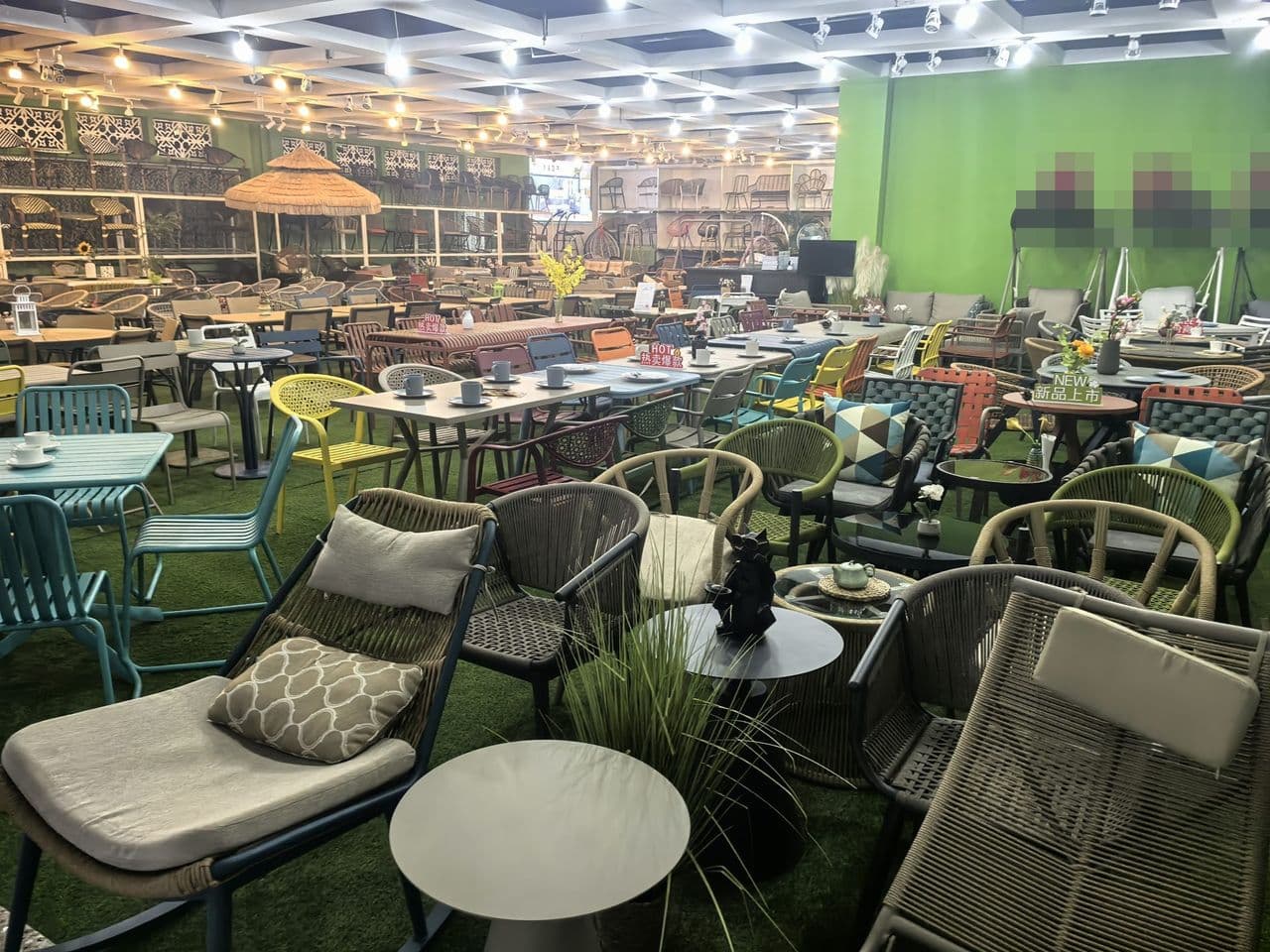
200+ SKUs on display. A good showroom tells you what a factory wants to sell. We cross-check it against what's actually running on the production line — catalogue-only products are a red flag for long lead times and quality drift.

Finished rattan sets, styled for buyers. Pretty — but we're looking past the styling at joinery, weave consistency, and frame alignment. The showroom is where we pick the golden samples that all future QC will be measured against.
What we check: Which SKUs are in stable production vs. catalogue-only. We select and seal golden samples here.
What goes wrong if you skip it: You order a “bestseller” that hasn't been produced in eight months. The factory re-learns your product on your dime.
Stop 3: The production line — can they deliver your volume?
▶ Watch: hand-weaving rattan on the production line (YouTube, 0:08)
Headcount, skill level, and line organisation tell us whether the factory can hit your quantity on your timeline — or whether your order will be quietly subcontracted.

Welding the aluminium frames. On outdoor furniture, the weld is where 90% of rust complaints start. We check weld consistency across units — not just the one perfect sample they sent you.

Grinding and finishing frames before weaving. Rough finishing here means coating failures later — the kind of defect that shows up six months into an Australian summer, not at the loading dock.
What we check: Worker count and skill, line capacity vs. your PO, in-process quality at each station.
What goes wrong if you skip it: Your 5,000-unit order goes to a 20-person workshop. Delivery slips six weeks, and quality varies unit to unit.
Stop 4: The details — where QC lives or dies

Weave tension, up close. Uneven tension looks fine in the showroom and falls apart on a customer's patio. During production inspections we pull random units and check this against the sealed golden sample — while the line is still running and it's still fixable.

Powder-coated aluminium frames waiting for weaving. Raw-material checks catch the problems that become warranty claims: thin coating, wrong alloy, poor weld prep. Caught here, it's a rework. Caught in Brisbane, it's a refund.
What we check: AQL sampling against golden samples, measurement checks, function tests — mid-production, not after.
What goes wrong if you skip it: You discover the defect when the container arrives. Rework in Australia costs 5–10x what it costs in Foshan.
Stop 5: The warehouse and the container — the last 5%

Finished goods awaiting packing. Volume like this tells us the factory ships regularly — regular shippers have stable processes. One-off producers don't.

Container loading, supervised. The last 5% of the job causes a disproportionate share of damage claims — wrong carton count, bad stacking, no moisture protection. We count, photograph, and supervise loading so your goods arrive the way they left the factory.
What we check: Carton count vs. packing list, stacking plan, moisture protection, container condition.
What goes wrong if you skip it: Perfect product, loaded badly, arrives broken. And good luck proving whose fault it was.
The point
This is what “verified supplier” means to us. Not a badge on a B2B website — a full day on the floor, a checklist, photographs, and a written report.
Every factory we recommend to an Australian brand goes through this. If it doesn't pass, we tell you — and we keep looking.
Want this done for your supplier? Our factory background check covers business verification, an on-site or video walkthrough like the one above, capacity assessment, and certificate checks — with a written photo report in 5 business days.
Next in the series: the 5-step audit checklist we use on every visit — download it as a printable PDF. Read part 2 →